Biostimulant or fertiliser?
Insight

Is a biostimulant a fertiliser?
The short answer is no.
Biostimulants and fertilisers perform different functions within crop production systems, although they are increasingly used together within modern agronomy programmes.
Fertilisers are primarily used to supply nutrients required for crop growth.
Biostimulants are used within crop programmes to influence plant processes linked to nutrient efficiency, crop resilience and overall crop performance through the growing cycle.
Understanding that distinction matters commercially.
As growers face increasing pressure from input costs, environmental variability and tighter margins, more attention is being placed on crop efficiency, marketable yield and consistency across the season.
This is one reason biostimulants are receiving greater attention across commercial agriculture.
What is a fertiliser?
Fertilisers are products designed primarily to supply nutrients essential for plant growth.
These nutrients usually include:
- Nitrogen (N)
- Phosphorus (P)
- Potassium (K)
- Secondary nutrients such as calcium, magnesium and sulphur
- Trace elements including zinc, manganese and boron
The role of fertilisers is to ensure crops have access to the nutrients required for growth, canopy development, root establishment, grain fill, tuber bulking and final yield production.
Without sufficient nutrient availability, crop performance is restricted.
Fertilisers remain fundamental to commercial crop production systems.
What is a biostimulant?
Biostimulants are defined by their function rather than simply their nutrient content.
According to EBIC, the European Biostimulants Industry Council, plant biostimulants stimulate natural plant processes linked to nutrient uptake, nutrient efficiency, abiotic stress tolerance and crop quality.
The European Union’s Regulation (EU) 2019/1009 similarly defines plant biostimulants as products that stimulate plant nutrition processes independently of the product’s nutrient content.
In practical crop management, fertilisers are used to supply nutrition, while biostimulants are typically included to support crop efficiency, establishment, stress management and marketable yield.
Fertilisers vs biostimulants
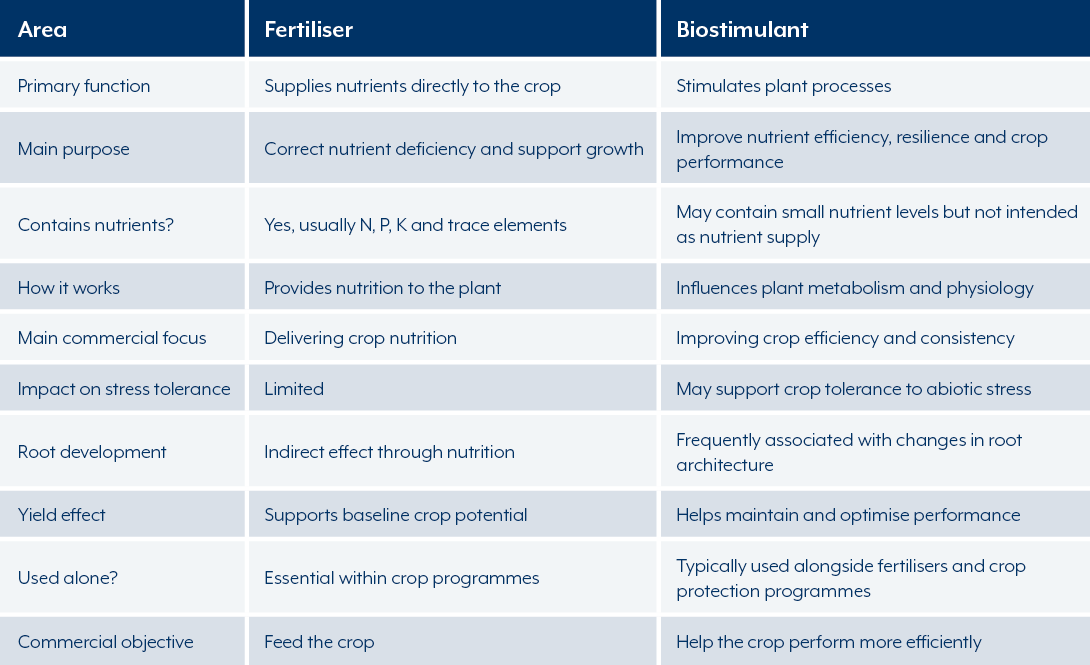
In practice, commercial growing programmes increasingly use both.
Fertilisers provide the nutritional foundation. Biostimulants are used to help crops utilise those resources more efficiently and maintain performance under variable growing conditions.
Why are biostimulants becoming more important?
Commercial crop production is operating under increasing pressure from weather variability, rising input costs and tighter production margins.
Growers are managing:
- Weather volatility
- Heat stress
- Drought periods
- Waterlogging
- Reduced agrochemical availability
- Rising fertiliser costs
- Pressure on input efficiency
- Greater market quality specifications
Published research suggests certain biostimulant technologies can support crop resilience, nutrient efficiency and yield stability, particularly where crops are exposed to environmental stress or variable growing conditions.
This is one reason why biostimulants have moved from niche interest to commercial growing programmes across potatoes, onions, cereals and vegetable crops.
How do biostimulants work?
Different biostimulant technologies influence different plant processes.
Biostimulants may include:
- Seaweed extracts
- Humic substances
- Amino acids
- Silicon
- Microbial strains
- Plant extracts
- Polyphenols and bioflavonoids
Maxstim programmes are based on complex bioflavonoid technology combined with amino acids, carbohydrates, organic acids, Ascophyllum nodosum extract and trace elements.
Research into bioflavonoids suggests they can influence pathways associated with:
- Root development
- Hormone signalling
- Photosynthetic activity
- Nutrient uptake efficiency
- Stress management
- Plant defence responses
Commercially, this matters because crop performance is rarely influenced by a single factor. Yield, quality and crop consistency are shaped continuously by interactions between nutrition, stress, environment and plant metabolism.
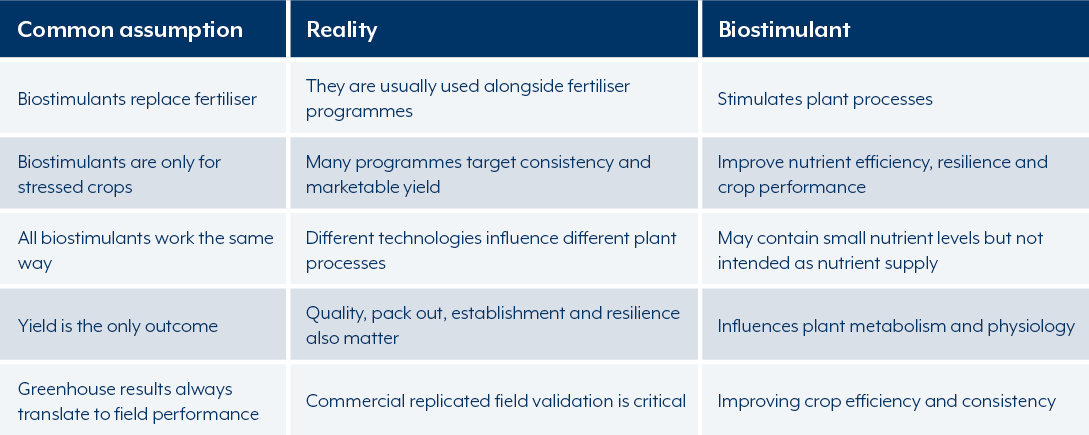
Common misconceptions about biostimulants
What does the field evidence show?
One of the historical challenges within the biostimulant sector has been inconsistency between controlled environment results and commercial field performance.
This is why replicated field validation is important.
Across 53 UK potato field trials conducted between 2022 and 2025, Maxstim programmes delivered:
- An average yield increase of 3.7 t/ha
- An average yield increase of 6.5%
- An average margin increase of £360/ha after treatment costs
The trials also demonstrated consistent improvements in skin finish and marketable yield across multiple potato varieties.
Across 23 onion field trials conducted between 2022 and 2025, Maxstim Agriculture+ and Cynosa™ programmes delivered reliable increases in marketable yield and measurable margin improvements across both red and brown onion production systems.
The replicated field data indicates consistent effects associated with crop performance, marketable yield, crop uniformity and margin improvement across multiple commercial growing environments.
Root development and nutrient efficiency
Root architecture plays an important role in:
- Nutrient accessibility
- Water uptake
- Crop establishment
- Plant resilience
- Crop consistency through the season
Maxstim research and field assessments have demonstrated significant increases in root mass and lateral root development across multiple crop types.
Improvements in root architecture can influence nutrient uptake efficiency, water accessibility and crop consistency throughout the growing cycle.
Final thoughts
Biostimulants occupy a different functional role within crop production systems and are increasingly being integrated into commercial agronomy programmes focused on efficiency, resilience and marketable output.
Fertilisers remain essential for supplying crop nutrition.
Biostimulants are being used to support crop performance, nutrient efficiency and crop consistency within increasingly variable growing environments.
For growers and agronomists, the commercial focus is increasingly centred on how effectively crops convert available resources into marketable yield and margin.
That is where replicated field performance becomes important.
Sources and further reading
• European Biostimulants Industry Council (EBIC)
• European Union Regulation (EU) 2019/1009 on plant biostimulants
• Frontiers in Sustainable Food Systems, “A complex biostimulant based on plant flavonoids enhances potato growth and commercial yields”
• Maxstim replicated potato field trial summary 2022–2025
• Maxstim replicated onion field trial summary 2022–2025
Contact the team to discuss how incorporating Maxstim into your crop programme could benefit you.
Tim Cannon
Email: tim.cannon@maxstim.com
Mobile: 07884 586191
Phil Kingsmill
Email: phil.kingsmill@maxstim.com
Mobile: 07860 269996
Leanne Taylor
Email: leanne.taylor@maxstim.com
Mobile: 07552 097554
Tony Kelly
Email: tony.kelly@maxstim.com
Mobile: 07974 435417