Why variability within a potato crop affects marketable yield
Conocimiento
In commercial potato production, total yield is only part of the picture.
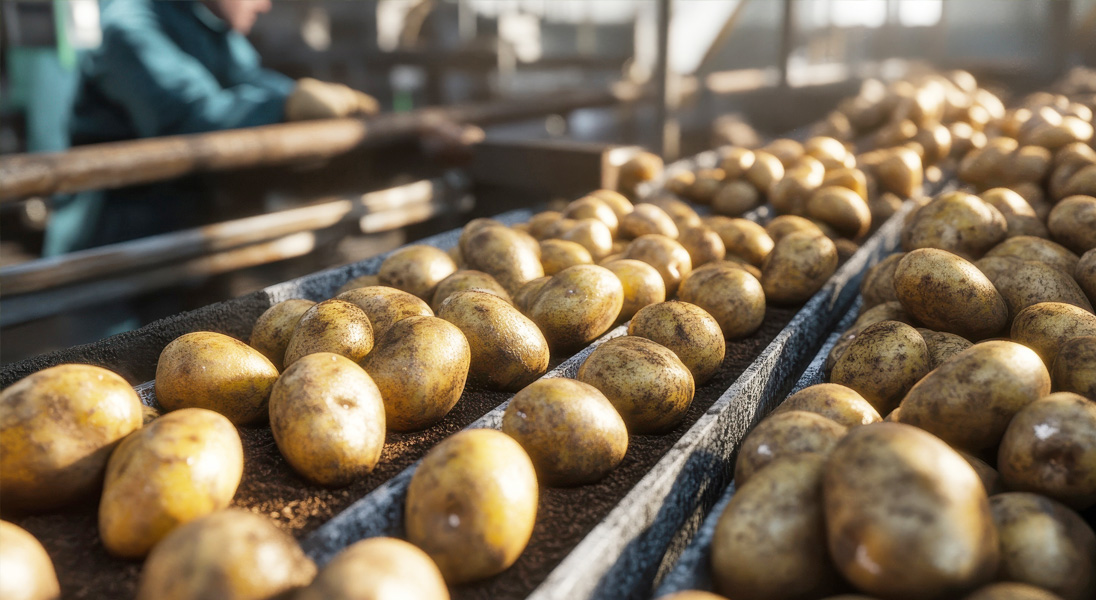
What often determines crop value is how much of that yield falls within market specification. A crop producing uneven tuber sizes, variable maturity or inconsistent skin finish can become significantly less predictable commercially, even where total tonnage remains strong.
This is why variability within a potato crop matters.
Early differences shape how the crop develops
Differences between plants are often small during establishment and can be difficult to detect early in the season.
A gap of a few days in emergence or early growth may seem minor initially. However, as the crop develops, these differences begin influencing how plants contribute to canopy formation, biomass production and overall crop performance.
Some plants establish stronger canopies earlier, intercept more light and progress through growth stages more quickly. Others develop more slowly and contribute differently to final yield.
From that point, the crop is no longer developing as a fully uniform system.
Variability influences how growth is distributed
As canopy development progresses, differences between plants become increasingly reflected in how growth is distributed across the crop.
Earlier developing plants intercept more light over a longer period and contribute more strongly to biomass accumulation. Later developing plants operate within a canopy structure that is already forming around them, where competition for light and space becomes greater.
This changes how evenly plants contribute to crop performance through the season.
At harvest, these differences become more visible through:
- Wider tuber size distribution
- Uneven crop maturity
- Reduced grading consistency
- Less predictable pack-out
For commercial growers, this affects not only total yield, but how much of the crop consistently meets market specifications.
Variability often becomes embedded within crop structure
By the time uneven grading becomes visible, the underlying differences within the crop are usually already established.
These differences all influence how evenly the crop develops across the field:
- Emergence timing
- Root development
- Early canopy formation
- Exposure to stress
Even in well managed commercial crops, establishment conditions vary between plants. Soil structure, moisture availability and temperature differences all influence how individual plants progress during the early stages of growth.
As the season develops, these differences become increasingly reflected in canopy structure, plant development and crop performance.
Why uneven crops can be difficult to realign
As the crop progresses through later growth stages, the patterns established during early development often remain in place.
Later improvements in growing conditions may support the crop overall, but they do not necessarily redistribute growth evenly between plants. Earlier developing plants often continue contributing more strongly to overall crop performance, while later developing plants continue contributing less.
This is one reason why uneven crops can be difficult to fully realign later in the season.
What this means commercially
A more variable crop behaves less consistently throughout the season.
Differences between plants can influence:
- Timing of tuber initiation
- Bulking rates
- Final tuber sizing
- Skin finish consistency
As variability increases, grading outcomes become harder to predict and a smaller proportion of the crop may fall consistently within target specification.
Where crop development is more aligned across the field, growers are more likely to achieve:
- Narrower grading spreads
- More consistent marketable yield
- Greater pack-out efficiency
- More predictable harvest outcomes
In many commercial potato systems, this consistency can influence crop value and market return.
Why early crop development matters
- The period from establishment through early canopy development plays an important role in shaping how the crop performs through the remainder of the season.
- Small differences during these stages can influence how growth is distributed across the crop and how consistently plants contribute to final yield and quality outcomes.
- Understanding how variability develops helps explain why commercial potato programmes increasingly focus on supporting crop establishment, maintaining early crop momentum and reducing differences between plants during the early stages of development.
- In commercial potato systems, the Maxstim Agriculture+ and Cynosa™ programme is used to support early crop development and improve crop consistency across the field.
Want to see the impact on your farm? Call the team to arrange a trial.
Tim Cannon
Correo electrónico: tim.cannon@maxstim.com
Móvil: 07884 586191
Phil Kingsmill
Correo electrónico: phil.kingsmill@maxstim.com
Móvil: 07860 269996
Leanne Taylor
Email: leanne.taylor@maxstim.com
Mobile: 07552 097554
Tony Kelly
Correo electrónico: tony.kelly@maxstim.com
Móvil: 07974 435417